|
I am a Software Engineer at GoRoots Technologies, where I build scalable web and mobile applications at the intersection of AI and cloud infrastructure. My work focuses on applied AI systems — from multi-agent orchestration pipelines to real-time health intelligence platforms. To this end, I lead AeroStream, a cloud-connected platform that captures and analyzes nasal breathing patterns in real time to support precision respiratory diagnostics and remote patient monitoring. I developed and published a patent for this system in India under the guidance of Prof. Yokesh Babu Sundaresan. I also co-developed OriginLayer, a forensic AI detection platform built around two novel algorithms — Dynamic Reliability-Weighted Fusion (DRWF) and Disagreement-Aware Confidence Calibration (DACC) — for detecting and attributing AI-generated images. The system achieves 95.3% detection accuracy across six major generators, with a 34.2% reduction in false-confidence predictions. A patent has been filed for this system, and the underlying research has been submitted for publication under Prof. E S Madhan. I received my B.Tech in Computer Science and Engineering from VIT Vellore with a CGPA of 8.21/10. |
|
|
My research develops computational methods and systems that bridge algorithmic innovation with real-world deployment. Below are selected patents and peer-reviewed publications arising from my work across applied AI, biomedical sensing, and forensic media detection. |
|
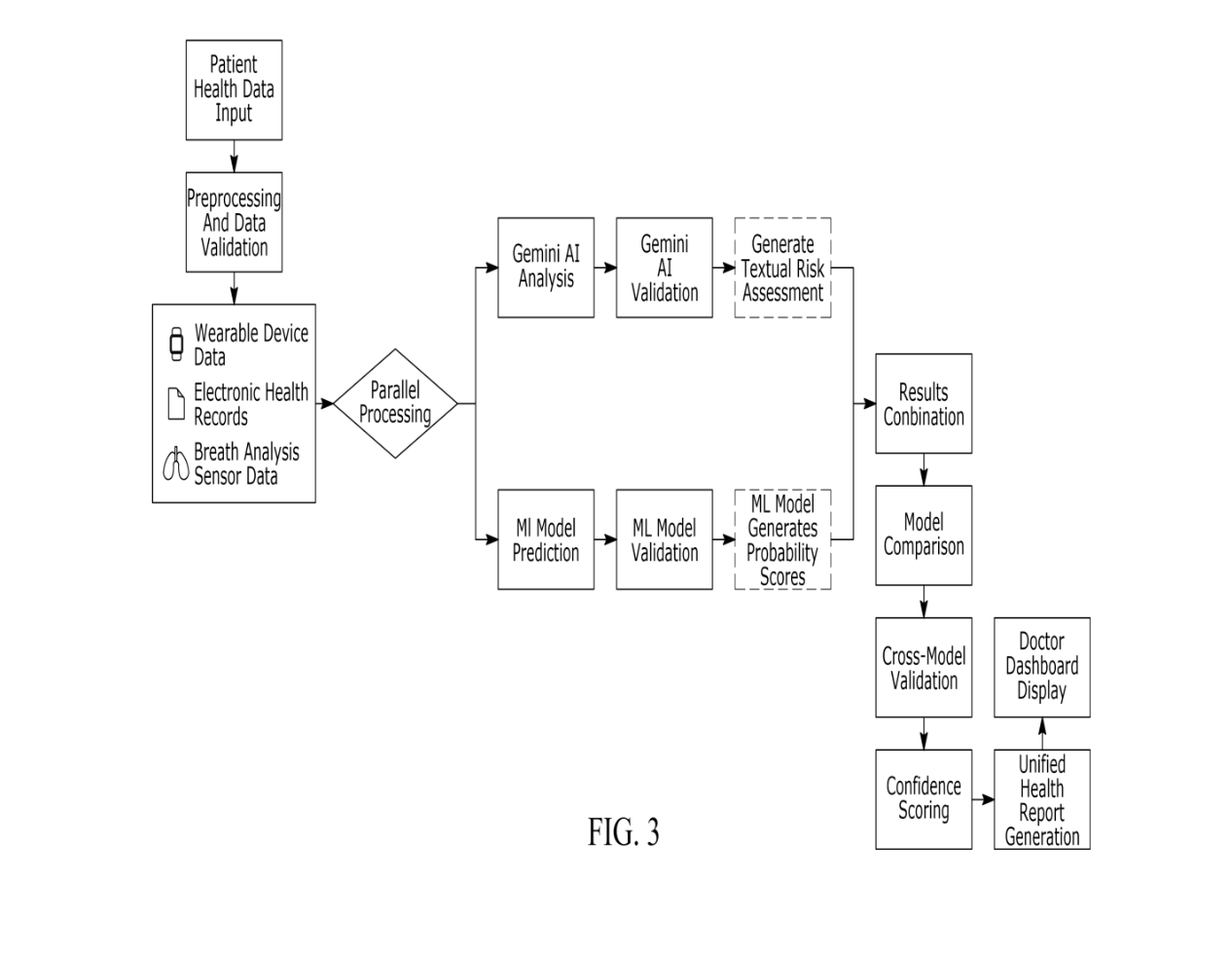
Rahul Yadav, Dr. Yokesh Babu Sundaresan, Dr. Kumaresan P, Oshim Pathan, Aashish Kumar Mahato Indian Patent Application IN202641010439 A1, Intellectual Property Office India, 2026 Patent We present a secured breath sensor array framework that fuses heterogeneous gas sensing modalities—metal oxide semiconductor, non-dispersive infrared, and quartz crystal microbalance arrays—with multimodal physiological monitoring on an edge computing platform. The system ingests volatile organic compound signatures from exhaled breath alongside continuous vital sign streams, applies embedded machine learning to derive a disease risk index, and cross-validates predictions through a parallel generative AI pipeline that synthesizes interpretable clinical reports with confidence-calibrated outputs. By integrating on-device inference, cross-model validation, and secure role-based telemedicine workflows, this architecture enables continuous, non-invasive disease screening while preserving patient privacy and clinical interpretability. |
|
My work sits at the intersection of machine learning, systems engineering, and product development. I build end-to-end systems — from multi-agent AI pipelines and forensic detection frameworks to cloud-native infrastructure and health intelligence platforms — with the goal of translating rigorous computational methods into deployable technologies. By coupling algorithmic innovation with production validation, I aim to solve engineering problems across conversational AI, computer vision, distributed systems, and applied biomedical sensing. All of these projects are my original work, and I retain full ownership and authorship of each. † |
|
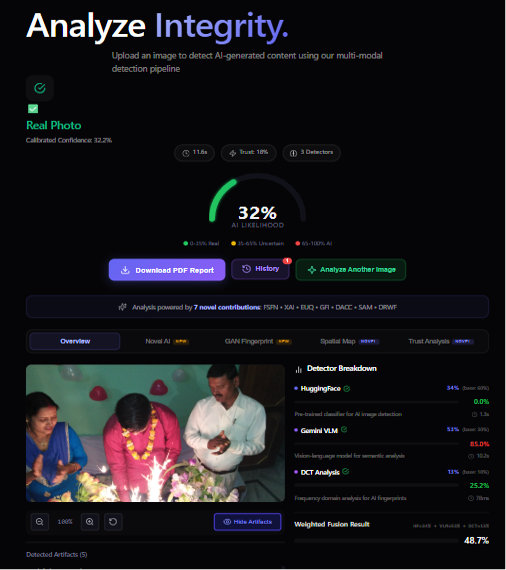
Next.js, React, Python, FastAPI, Google Gemini Vision, HuggingFace Transformers, DCT frequency analysis code We introduce a multi-modal forensic pipeline for detecting AI-generated images by fusing watermark scanning, DCT spectral analysis, Gemini Vision semantic inspection, and local ViT classification through Dynamic Reliability-Weighted Fusion (DRWF) and Disagreement-Aware Confidence Calibration (DACC). The platform produces explainable, confidence-calibrated verdicts with spatial artifact maps and GAN fingerprint attribution, achieving 95.3% accuracy across six major generators with a 34.2% reduction in false-confidence predictions. |
|
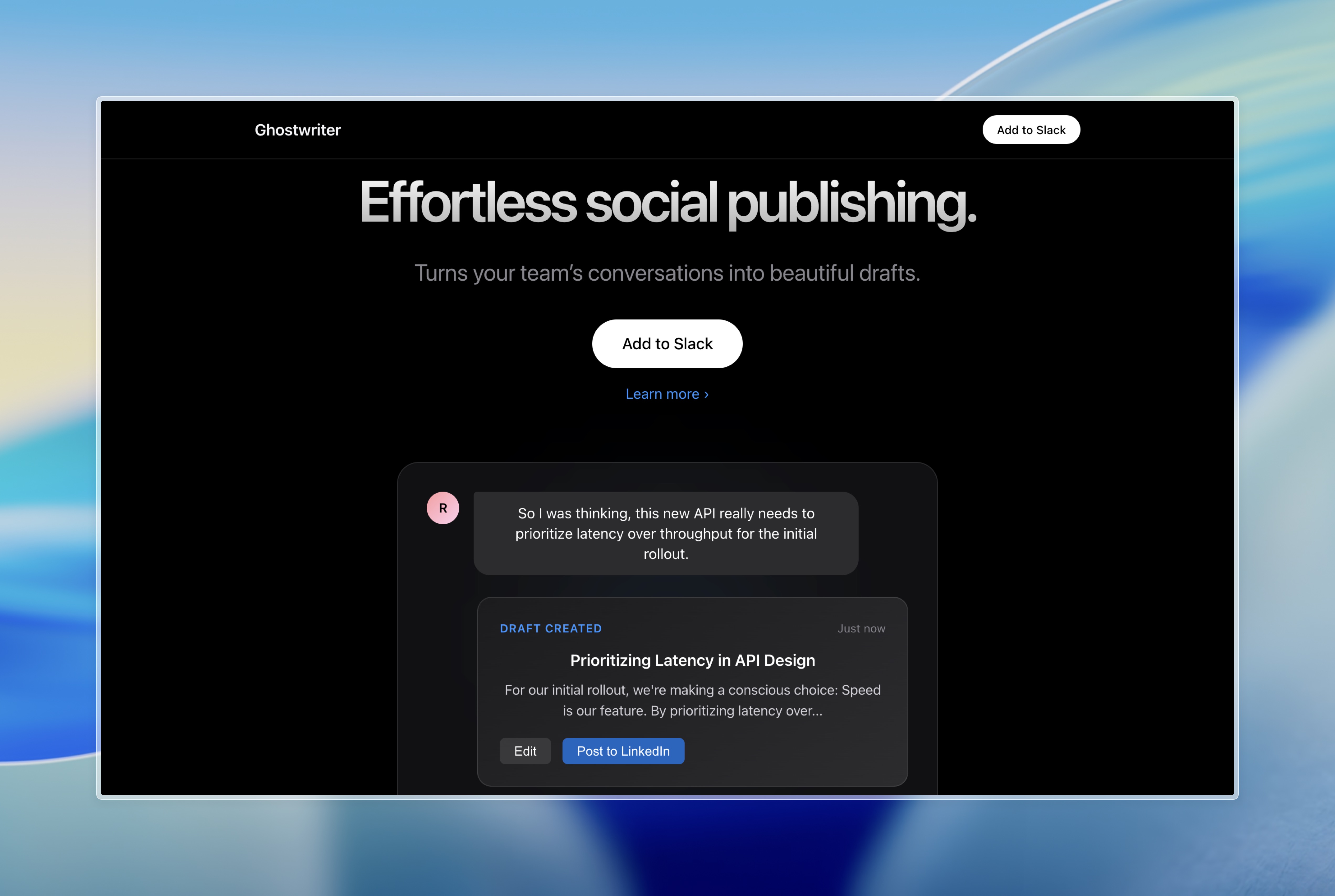
Python, FastAPI (ASGI web framework), Uvicorn (ASGI server), Google Gemini, Leonardo.ai, Supabase, Redis, Meta Slack API Link / code / Demo I introduce Ghostwriter, a Slack AI bot that passively monitors team conversations and automatically generates publication-ready social media drafts for LinkedIn and X (Twitter). The system uses dual-trigger architecture (3-minute silence gap or 100-message volume threshold) to capture complete conversational contexts, implements semantic overlap through a sliding window of the last 20 messages to preserve idea continuity, and integrates Leonardo.ai for context-aware visual generation. Built with Gemini for signal-to-noise filtering, Supabase for long-term memory to prevent duplicate suggestions, and ephemeral Redis processing for privacy-compliant chat log handling. Delivered via private DM with interactive thread-based refinement, achieving production-grade performance with OAuth 2.0 authentication and stateless encrypted processing. This demonstrates scalable conversational AI architecture applicable to enterprise content automation workflows. |
|
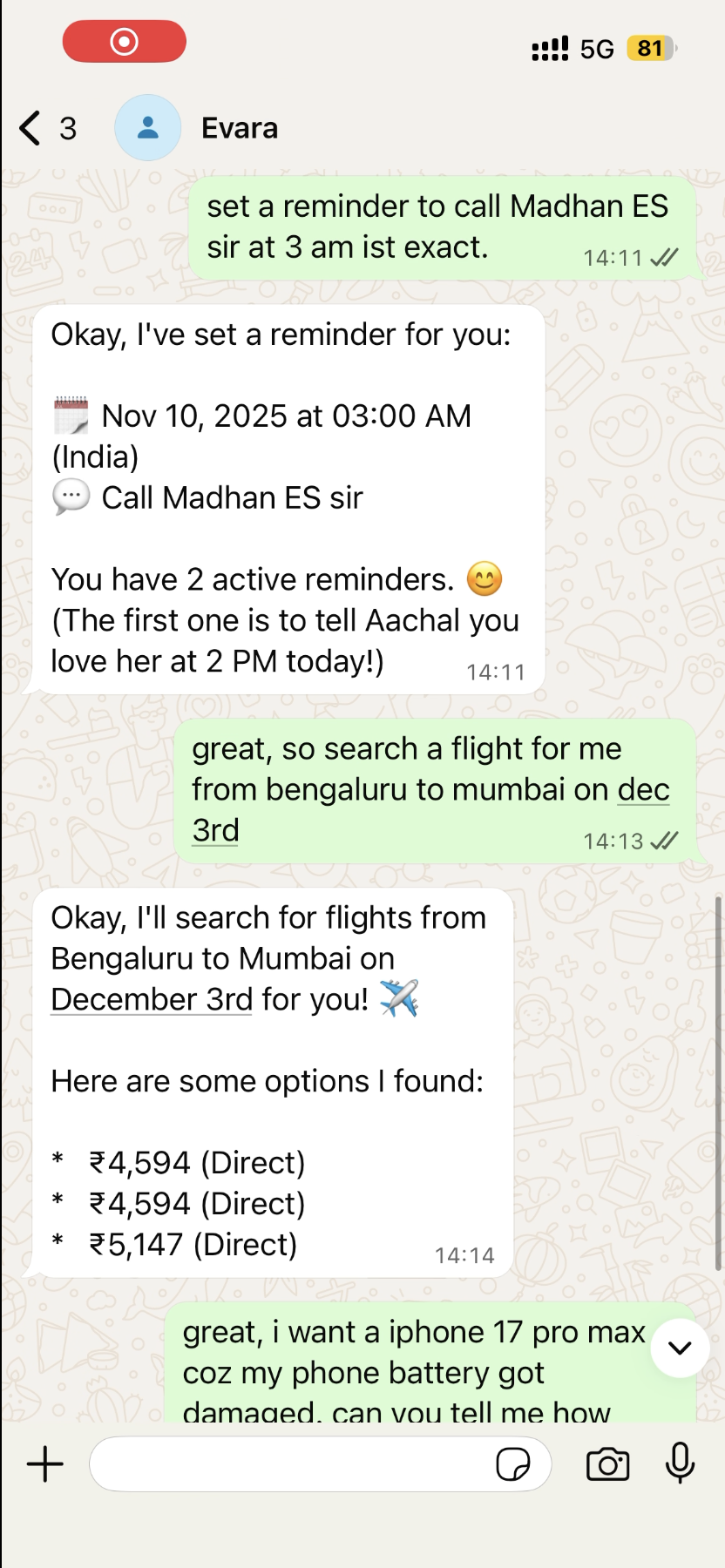
Python,FastAPI (ASGI web framework),Uvicorn (ASGI server),Google Gemini,Custom orchestrator, Meta WhatsApp Business AP Link / code / Demo I introduce Evara, a WhatsApp AI agent that automates personal tasks through custom orchestration and tool-augmented reasoning, bypassing frameworks like LangChain. The system integrates real-time APIs for flight search, price tracking, and reminders while maintaining persistent conversation memory, achieving production-grade performance with 24/7 deployment. This demonstrates scalable agent architecture applicable to consumer AI products. |
|
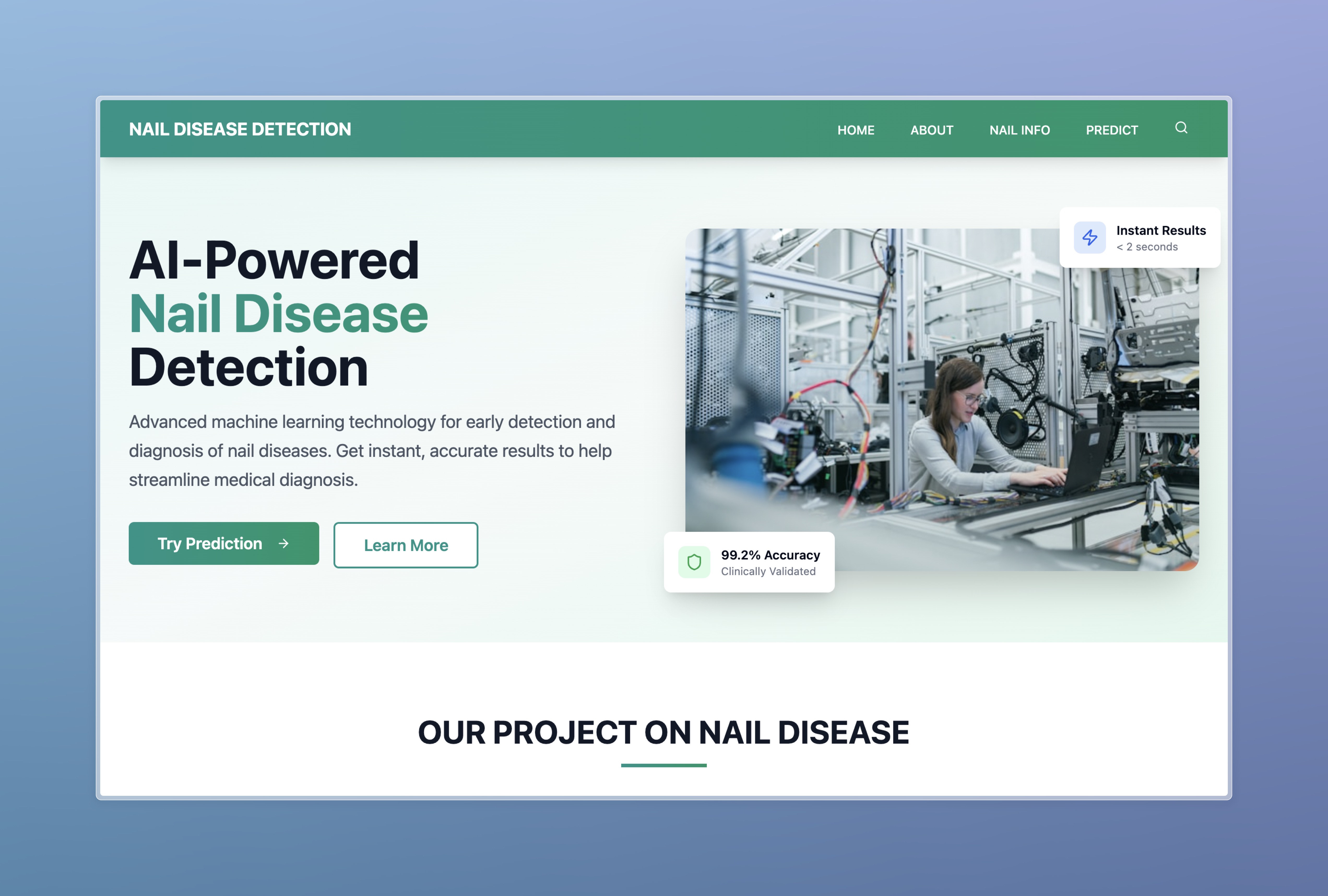
Next.js,Python,Python Web Frame works,CNN,IBM Watson,Deep Learning Link / code / Demo I led the development of the Nail Disease Diagnosis System, an AI/ML-powered platform designed to detect early-stage diseases through analysis of human nail images. Users can upload images of their nails, and the system returns diagnostic insights in real time. By training a deep convolutional neural network on a large, curated dataset, we achieved a validation accuracy of 97.8% with minimal loss, demonstrating strong generalization performance. The system is optimized for low-latency inference and is built with scalability and user accessibility in mind. |
|
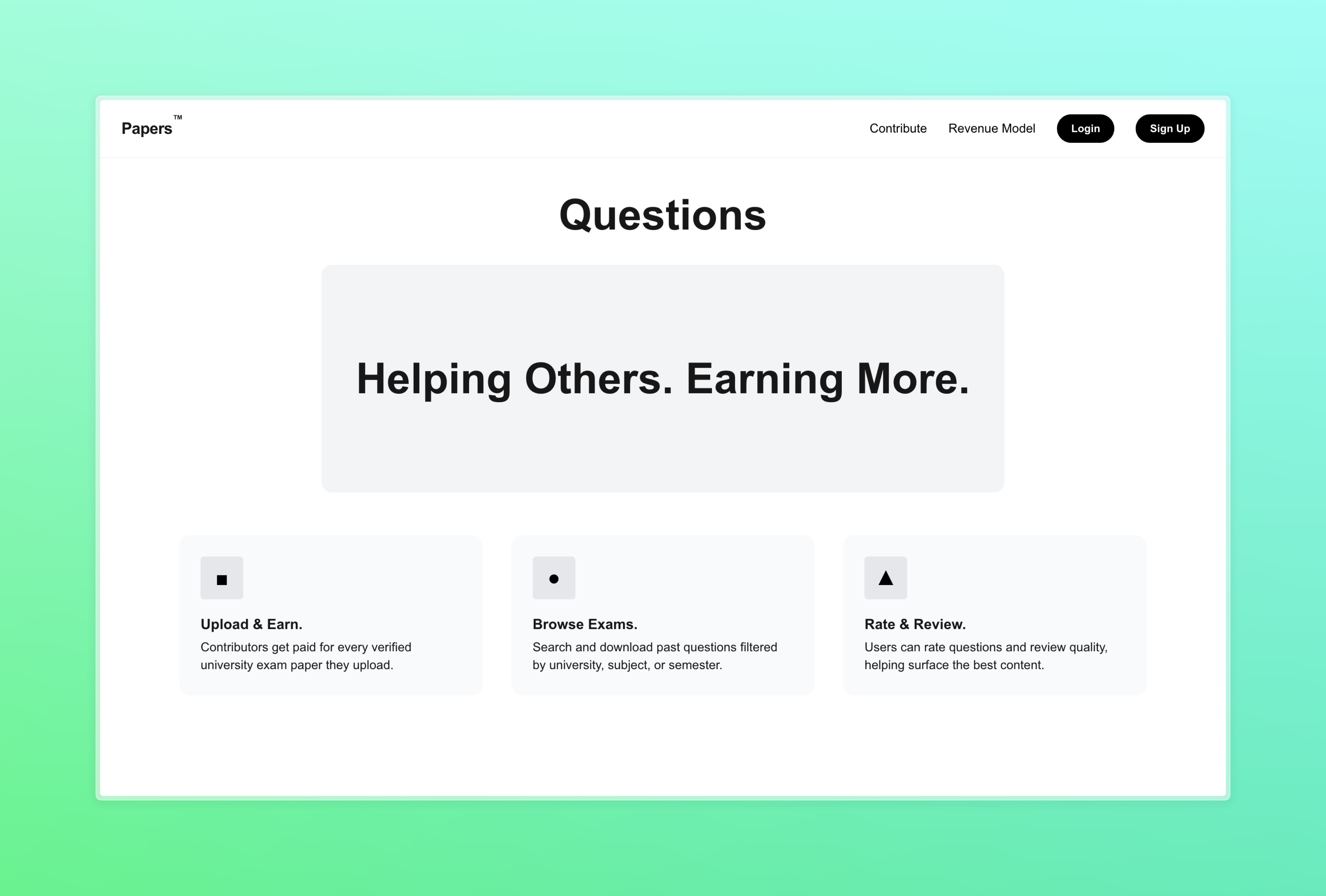
Next.js, Supabase, Google Gemini, Twilio, Vercel Link / code I built Uni-papers.com as an AI-powered academic platform where students can access, upload, and monetize university-level papers. By combining smart search with auto-review tools, the site helps students write better, faster — while earning revenue through paper uploads and Google AdSense integration. |
|
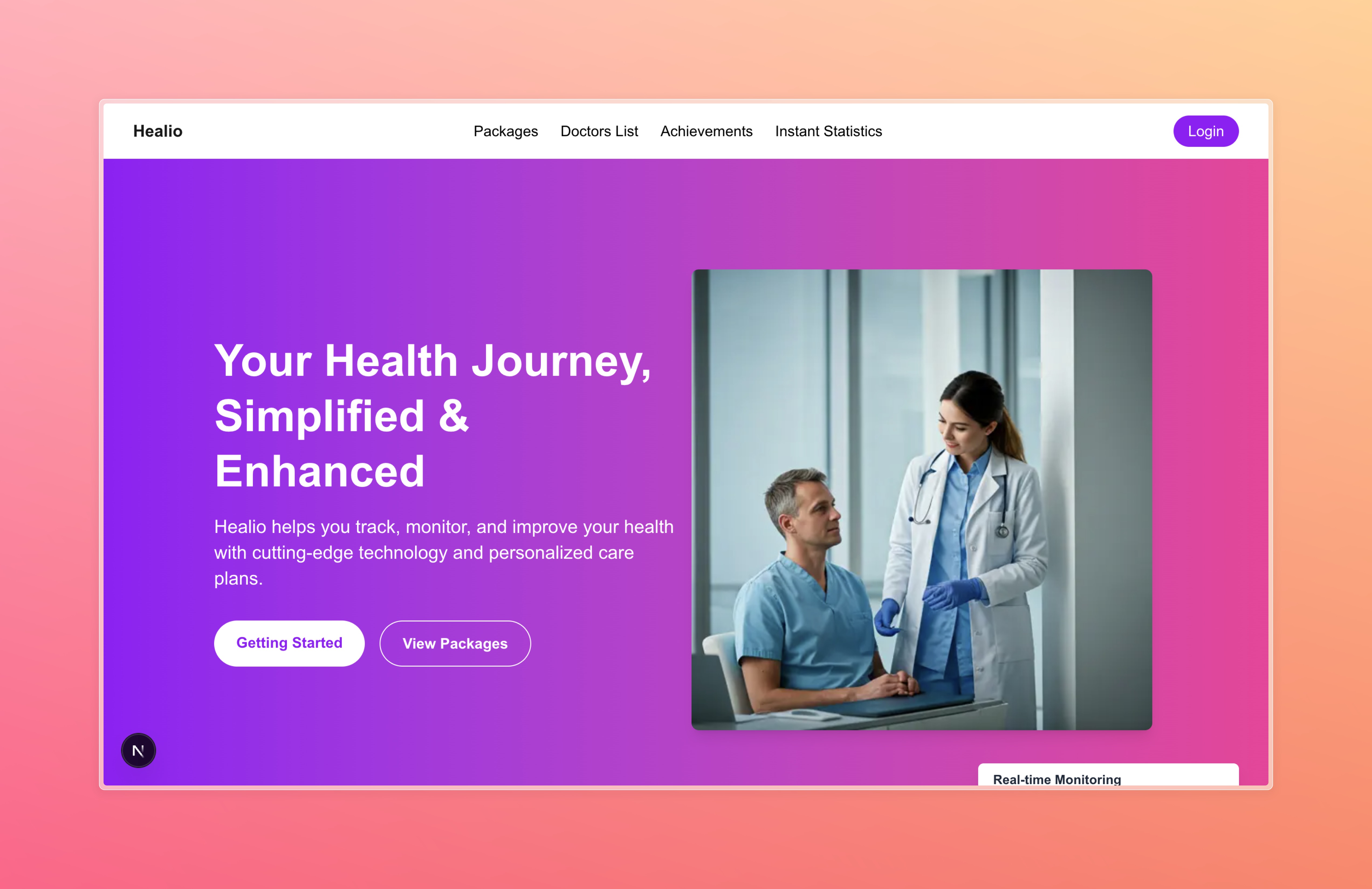
Next.js, Azure, Tailwindcss, Supabase, Vercel, Twilio, Custom ML model, GPT Link / code We introduce AeroStream, a contactless disease screening pipeline that analyzes breath signals using large language models, achieving early detection of respiratory and metabolic conditions. This approach improves accessibility and diagnostic speed without increasing hardware or computational cost. |
|
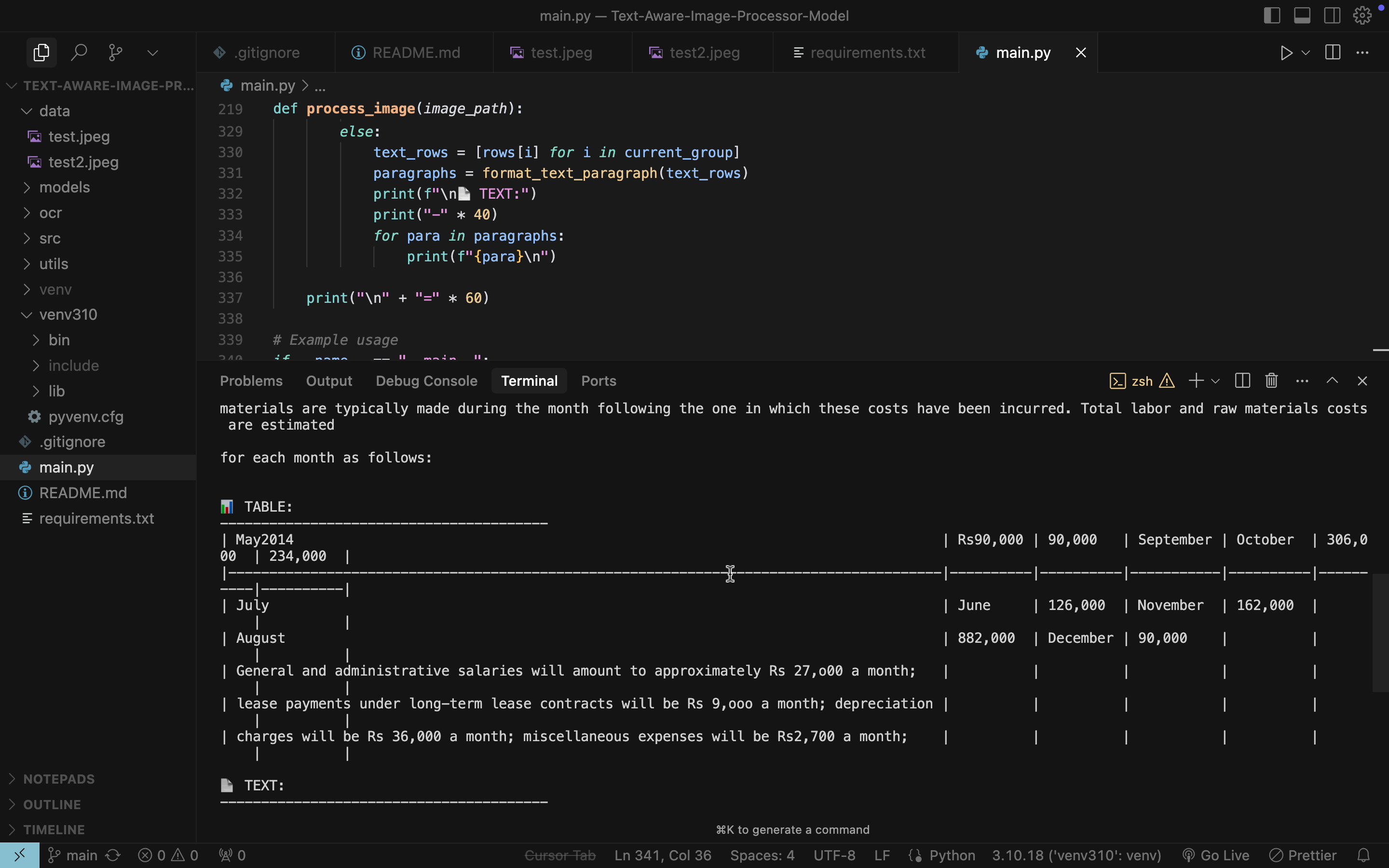
opencv-python, matplotlib, numpy, pandas, torch, torchvision, tqdm, pytesseract, paddleocr code We propose a two-stage OCR pipeline that first detects the presence of text before running full recognition, reducing compute usage by over 70%. This architecture enables scalable, cost-efficient document processing without compromising OCR accuracy. |
|
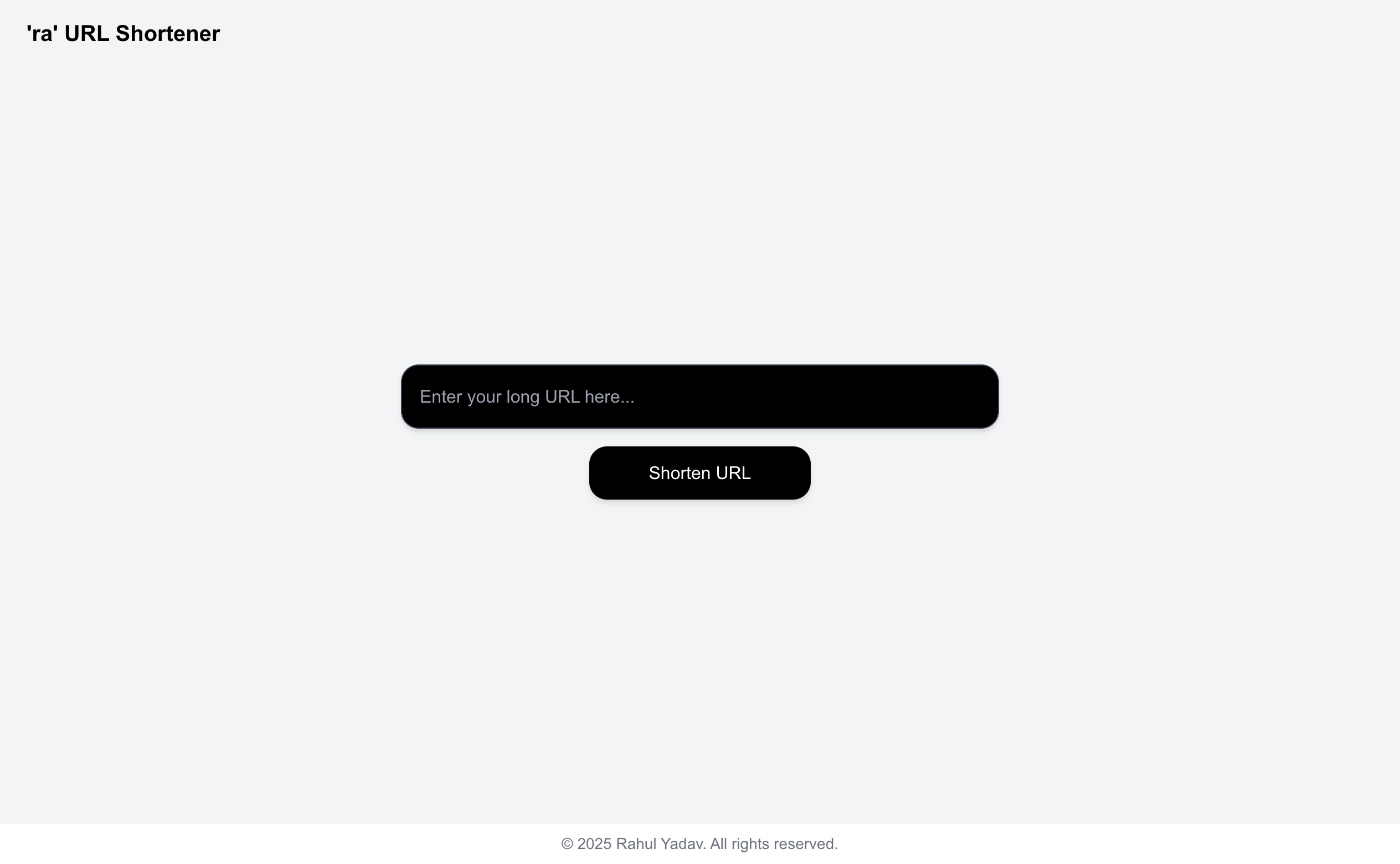
Nextjs, AWS Lambda, S3, DynamoDB, Cloudflare Link / code We developed a high-availability truley free URL shortener using a fully serverless architecture—Next.js on the frontend, with AWS Lambda, S3, and DynamoDB on the backend, secured and accelerated via Cloudflare. The system is optimized for low-latency redirection and infinite horizontal scalability with near-zero infrastructure overhead. |
|
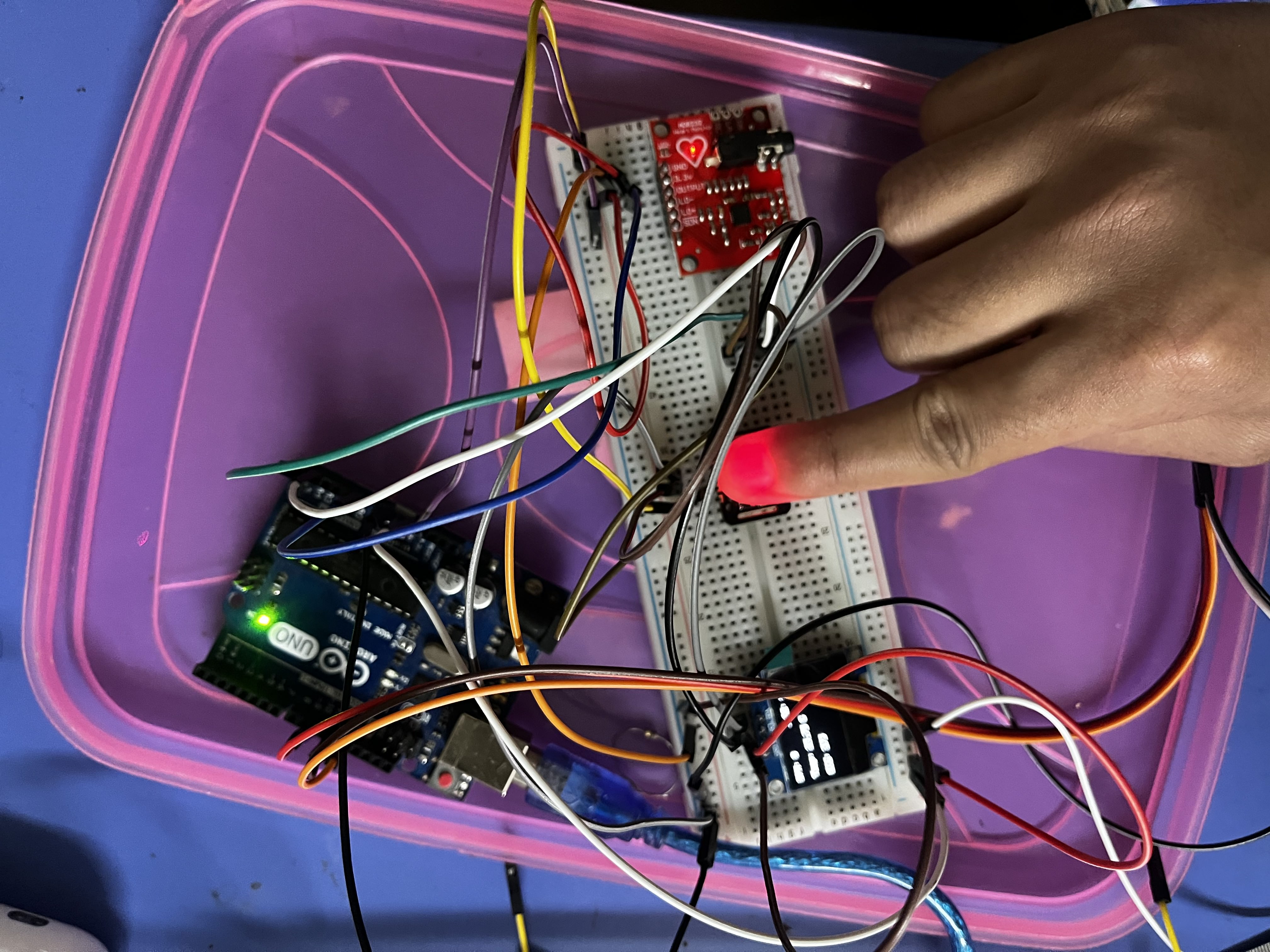
Sensors: AD8232 , MAX30102 , BMP180, MLX90614 Other Modules: Raspberry pi 4, Display module code We present a wearable disease detection system leveraging multimodal biosensors and hierarchical ML inference on Raspberry Pi 4. By integrating vitals and breath biomarkers with patient history, our system achieves real-time risk prediction with low-latency, on-device intelligence and cloud-based reporting. |
|
In this rapidly evolving world, I’m deeply passionate about Artificial Intelligence and emerging technologies. I actively explore and experiment to stay ahead in the tech curve, constantly learning and building. This project reflects that vision—a wearable disease detection system designed to deliver accessible, real-time health insights to both patients and doctors through intelligent, sensor-driven design. |
|
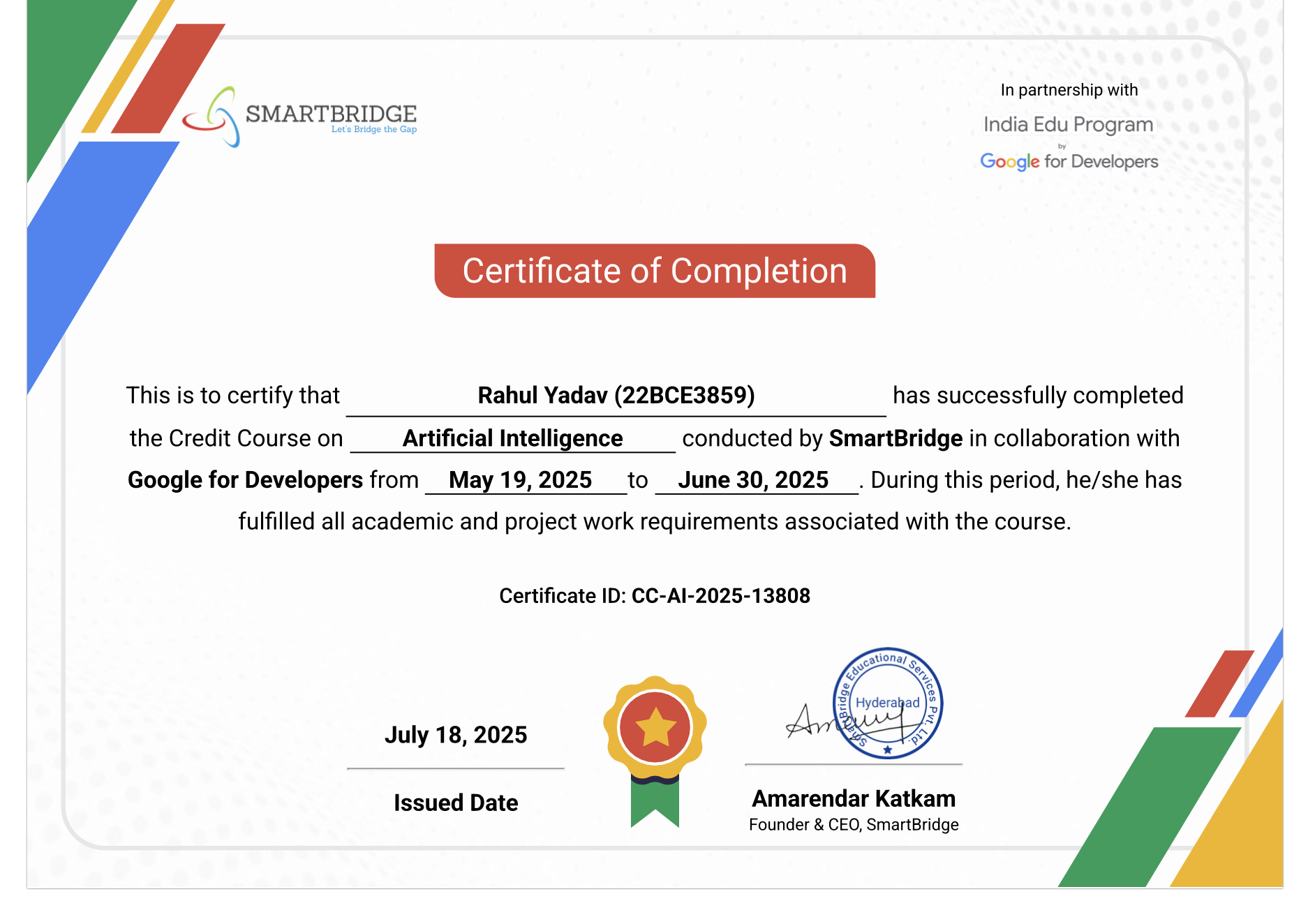
From May to June 2025, I completed an intensive AI credit course by SmartBridge in collaboration with Google for Developers. Focused on hands-on project work, the program strengthened my ability to build and deploy machine learning models, aligning with my goal of engineering scalable, AI-driven systems. |
|
To build a well-rounded foundation, I earned key credentials from IBM SkillsBuild—covering core AI principles alongside strategic planning for cloud-based deployments. This dual focus equips me with a holistic view of designing and delivering modern, scalable applications. |
|
To strengthen my AI foundation, I earned Google Cloud credentials focused on generative technologies—covering LLMs, attention mechanisms, image generation, and Gemini API development. The coursework also emphasized Responsible AI, aligning technical depth with ethical design. |
|
In addition to technological innovation, I am passionate about leadership and business, and strive to create solutions that empower people and improve lives. This project reflects that vision—a wearable disease detection system that brings accessible, real-time health insights to patients and doctors through intelligent, sensor-driven design. |
|
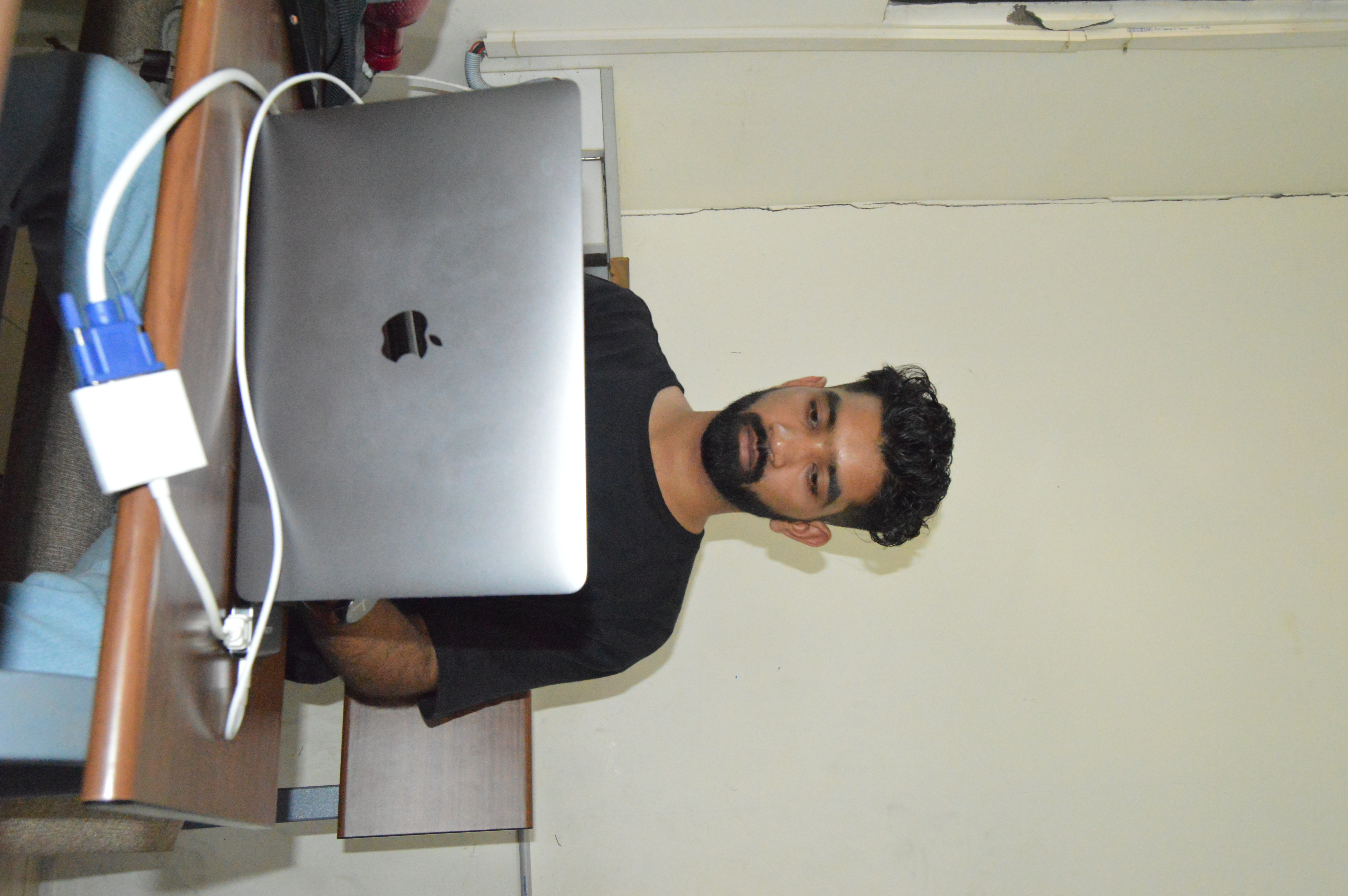
As a Software Engineer at Aarogya, I developed a zero-cost health data platform for rural Nepal, combining React Native and Google APIs to support underserved communities. Beyond engineering, I contributed to business strategy, logistics, and patient outreach—driven by a mission to make healthcare more accessible and impactful. |
|
My education has been driven by a deep curiosity for technology, innovation, and real-world impact. I’ve focused on building a strong foundation in computer science while actively applying my skills through research, projects, and interdisciplinary learning that bridges engineering, healthcare, and entrepreneurship. Looking ahead, I aspire to expand my knowledge and grow through opportunities at some of the world’s leading institutions. |
 |
Vellore Institute Of Technology |